




Flame-resistant clothing - A life-saving choice!
Flame-resistant clothing plays a crucial role in ensuring employee safety in the workplace. They provide protection against electrical hazards, fire, heat, and liquid chemicals. This type of protective equipment is essential for employees in the electrical and power industries, petrochemicals, and welding, or in any other industry where there is a risk of exposure to flames or intense heat.
We at Arbetsskydd Express AB are committed to providing workwear that adheres to strict safety standards and guidelines. Our goal is to minimize the risk of injuries at work.
Safety standards are communicated through symbols on the labeling or packaging of protective clothing. These symbols indicate that the garment has been certified to meet the specific requirements for these standards, providing a quick overview of the type of protection offered. This ensures that users can easily choose appropriate equipment for their safety needs.
Among our products, you will find clothing certified according to the following standards
EN ISO 11612: Garments with this symbol offer protection against various heat risks, including flames, radiant heat, convective heat, and splashes of molten metal.

EN ISO 11611: These garments protect the wearer from sparks, splashes, and heat during welding, cutting, and similar work.
EN ISO 1149: Designed for wearers in environments with a risk of explosions (ATEX environments), for example with flammable gases or dust.
EN 13034: These garments provide adequate protection in various work environments where liquid chemicals are handled.
IEC 61482-1-2: Aims to reduce the risk of burns and injuries from electric arcs.
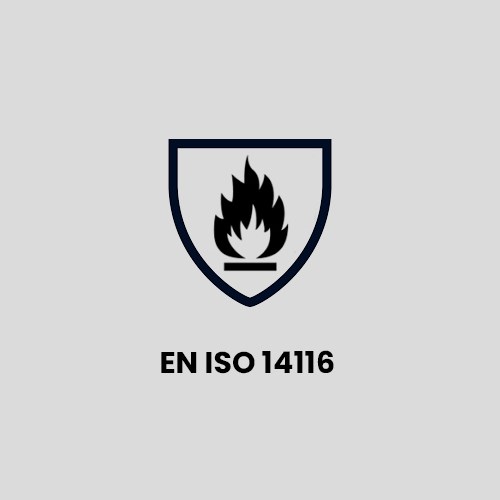
EN ISO 14116: Designed to protect workers from brief contact with small flames and prevent the spread of flames.
ASTM F1959/F1959M
ASTM F1959/F1959M: Although it does not have a specific symbol, this standard is directly referenced for protective clothing against electric arc, often mentioned together with the ATPV value (Arc Thermal Performance Value) and/or the HAF percentage (Heat Attenuation Factor).
